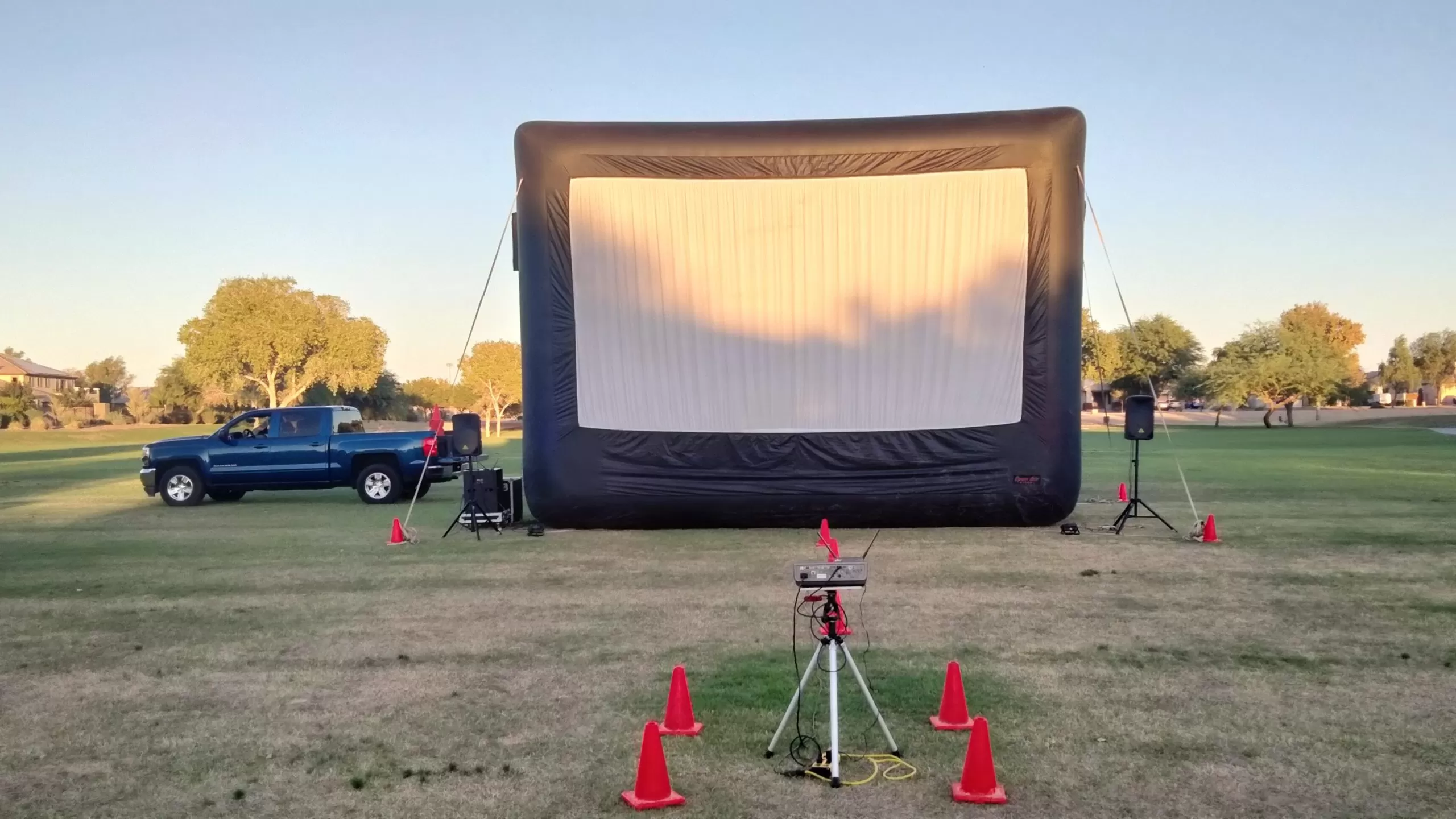
It's one of the most common questions we get: "Can we start the movie at 5 PM while it's still light out?"
We get it. You've got guests arriving in the afternoon, the kids are hyped, and waiting until dark feels like a long time. So here's the honest answer — no, outdoor movie projection in full daylight doesn't work. But understanding why will actually help you plan a better event.
Why Projectors and Daylight Don't Mix
A projector works by shining a focused beam of light onto a screen. The image you see is essentially light competing with every other light source in the environment. In a dark room, your projector wins easily. Outside on a sunny afternoon in Arizona? It doesn't stand a chance.
Here's the numbers behind it:
- A bright sunny day produces roughly 100,000 lux of ambient light
- A shaded outdoor space still has 10,000–20,000 lux
- Even a high-end 5,000-lumen projector (like the cinema-grade unit in our Gold package) produces the equivalent of about 500–700 lux on a 20-foot screen
That's a 20-to-1 disadvantage — at minimum. The result isn't a dim picture. It's essentially a white sheet with a faint ghost of an image that nobody can see or enjoy.
Even "daylight projectors" marketed online — the ones advertised at 8,000 or 10,000 lumens — can't beat full Arizona sun. In direct sunlight, there is no projector on the consumer or professional market that produces a watchable image outdoors on a fabric screen.
What About Shade or Overcast Days?
Partial shade and cloud cover do help, but not enough to make afternoon projection practical in most scenarios.
A heavily overcast day in Tucson brings ambient light down to roughly 1,000–5,000 lux — which is still 2–10x more than what a projector can produce on a large screen. You might get a faintly visible image, but the colors will be washed out, contrast will be poor, and anyone beyond the first few rows won't see much at all.
Shade from buildings or trees helps at the edges but rarely covers an entire audience seating area evenly. And Arizona's famous "partly cloudy" afternoons can flip to full sun in minutes.
When Can You Start the Movie?
The magic window is 15–20 minutes after official sunset, once the sky transitions from golden hour to true dusk. At that point, ambient light drops fast — the projector takes over, and the picture looks exactly the way it should.
Here's what that means in practice for Tucson throughout the year. Arizona does not observe Daylight Saving Time, so sunset times are predictable and consistent:
| Month | Tucson Sunset | Earliest Movie Start |
|---|---|---|
| January | ~5:35 PM | ~5:55 PM |
| February | ~6:05 PM | ~6:25 PM |
| March | ~6:25 PM | ~6:45 PM |
| April | ~6:45 PM | ~7:05 PM |
| May | ~7:10 PM | ~7:30 PM |
| June | ~7:28 PM | ~7:48 PM |
| July | ~7:20 PM | ~7:40 PM |
| August | ~6:55 PM | ~7:15 PM |
| September | ~6:15 PM | ~6:35 PM |
| October | ~5:45 PM | ~6:05 PM |
| November | ~5:25 PM | ~5:45 PM |
| December | ~5:22 PM | ~5:42 PM |
Pro tip: Use timeanddate.com to get the exact sunset time for your specific event date and city. For Phoenix, add about 2–3 minutes to Tucson's times.
The good news: winter and fall events in Arizona start earlier than anywhere else in the country. A December birthday party can have the movie rolling before 6 PM. That's hard to beat.
What If My Event Has to Be in the Afternoon?
If your event genuinely can't run past sunset — a school event, a daytime birthday party, a company picnic — there are a few realistic options:
1. LED Video Walls Large-format LED panels produce their own light instead of reflecting a projector beam, so they work in any lighting condition. The tradeoff: they're significantly more expensive to rent (typically $2,000–$5,000+), require a power-hungry setup, and lack the cinematic charm of a big inflatable screen under the stars.
2. Schedule a "Dusk Start" Design your afternoon around the movie, not the other way around. Host games, food, and socializing while it's light. When the sun goes down, the movie becomes the grand finale. Guests get the full outdoor cinema experience — and honestly, the anticipation makes it better.
3. Move Indoors For strictly daytime corporate presentations or daytime youth events, a large indoor space with blackout curtains works perfectly with a standard projector. It's not an outdoor cinema experience, but it gets the job done.
How We Handle It at Desert Air Cinema
Our team arrives 60–90 minutes before sunset to set up, calibrate audio, and do a full test run while it's still light. That way everything is dialed in before guests are seated, and the moment the sky darkens, we're ready to roll.
We don't rush the setup, and we don't start the movie early just because someone asks. After 1,500+ events, we know the difference between a great show and a forgettable one — and starting too early is one of the easiest ways to land in the second category.
If you're planning a summer event in June or July, a 7:45–8:00 PM start is normal and expected. Build your event schedule around it. Guests who know what to expect are guests who have a great time.
The Bottom Line
Outdoor movie projection is a nighttime experience by nature. The darkness isn't a limitation — it's literally what makes it magical. That giant screen glowing under the Arizona stars, the sound system filling the warm night air, the whole crowd reacting together to the same movie moment — none of that happens at 4 PM.
Plan your event around sunset, and you'll have one of the most memorable nights your guests have ever attended.
Want help picking the right screen size or figuring out timing for your event? Our quote calculator walks through it step by step, or you can chat with our AI assistant right on this page — it knows the full calendar and can give you a custom start-time recommendation based on your event date.