Everyone shops for an outdoor movie by screen size. It's the visible number, it's what looks impressive in photos, and it's the first thing anyone asks about.
But if you've ever been at an outdoor screening that didn't work, think back to why. It's almost never that the picture was too small. It's that you couldn't make out the dialogue over the traffic, or that the people in back gave up and started talking, or that everything sounded thin and far away. Audio is what fails at outdoor movie events, and it fails quietly enough that the host often doesn't realize it's happening.
Outdoors, There Are No Walls
This is the whole problem in one sentence. Indoors, sound bounces off walls and ceilings and comes back to you. A modest speaker in a living room sounds full because the room is doing half the work.
Outdoors, none of that happens. Sound leaves the speaker and keeps going. Two things follow:
The inverse square law. Sound pressure drops about 6 dB every time you double your distance from the source. A speaker that's comfortably loud at 10 feet is 6 dB quieter at 20 feet, 12 dB quieter at 40, and 18 dB quieter at 80. By the back row of a 125-person seating area, a home Bluetooth speaker is essentially background noise.
No bass reinforcement. Low frequencies are what make a movie feel like a movie — the score, the rumble, the weight in an action scene. Without walls, bass disperses immediately. This is why outdoor audio so often sounds "thin" even when it's technically loud enough. It's not missing volume; it's missing everything under about 150 Hz.
What You're Competing With
Your soundtrack isn't playing into silence. A typical Tucson backyard or park at 8 PM has an ambient noise floor of 40–50 dB — HVAC units, distant traffic, pool equipment, cicadas. Near an arterial road it's 55–65 dB.
For dialogue to be comfortably intelligible, you want it landing about 15–20 dB above that noise floor at the back row, not the front. That's the number that matters, and it's the number a consumer speaker can't hit without distorting.
| Setup | Realistic comfortable audience |
|---|---|
| Portable Bluetooth speaker | 5–10 people, very quiet yard |
| Soundbar on an extension cord | 10–15 people |
| Home A/V receiver + bookshelf speakers | 20–30 people |
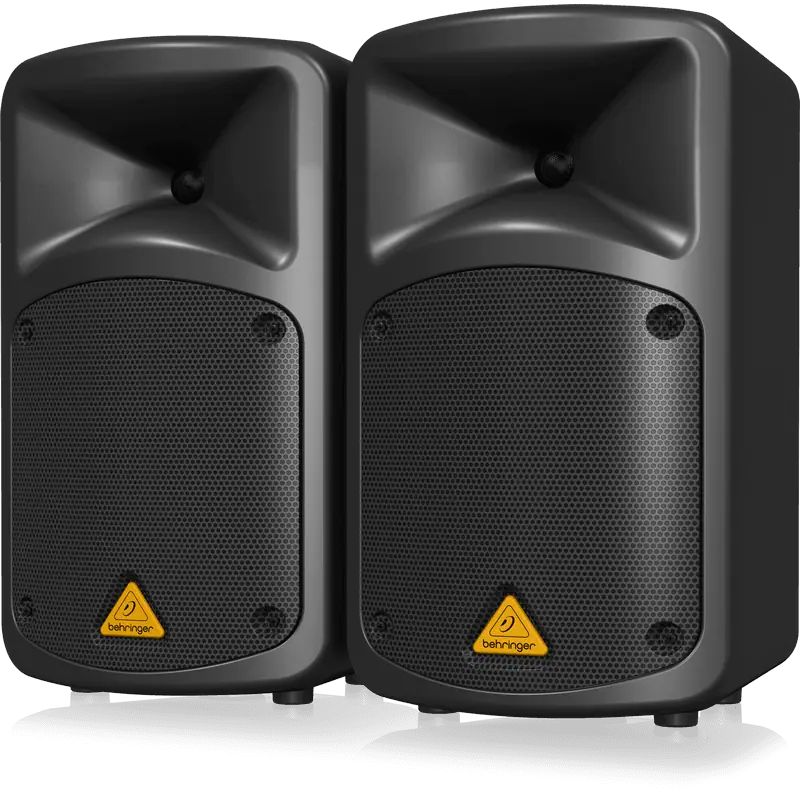
| Powered PA speakers on stands | 75–150 people |
| PA with subwoofer | 150–300+ people |
That table is the single most useful thing in this article. Most disappointing backyard movie nights are a row-three setup being asked to do a row-six job.
Why Height and Placement Beat Volume
Turning it up is the wrong first move. Almost every outdoor audio problem is solved better by geometry.
Get the speakers off the ground. A speaker sitting on the grass fires its energy into the bodies in the first two rows, which absorb it. On a 6-foot stand, the sound travels over the front rows and reaches the back. This one change is worth more than doubling your amplifier power.
Angle them down and inward. Speakers aimed straight out over the audience send most of their energy into your neighbor's yard. Tilted down toward the back third of the seating area, they cover the crowd evenly and spill less.
Flank the screen, don't center them. Two speakers at the left and right edges of the screen, angled inward, give you even coverage across the width of the seating area and put the sound where the picture is.
Stay under the delay threshold. If you add a second pair of speakers further back, they need to be delayed to match the front pair — otherwise guests in the middle hear a slap echo. Under about 30 milliseconds of difference (roughly 34 feet) the ear merges the two. Beyond that, it's noticeably wrong. This is why more speakers isn't automatically better.
Two well-placed speakers on stands will outperform four badly placed ones every single time.
Being a Good Neighbor
The flip side of "outdoors has no walls" is that your movie doesn't stop at your property line. Sound carries — especially bass, which travels much further than dialogue and is what neighbors notice.
A few things that keep events uneventful:
- Check the local noise ordinance. Most Tucson-area jurisdictions have quiet hours starting at 10 or 11 PM. That's typically not a problem for a 7:30 start, but a summer double feature can run into it.
- Aim away from the nearest homes. Screen orientation is usually flexible — use it.
- Tell the neighbors. A heads-up a few days out prevents almost every complaint. Inviting them prevents the rest.
- Ride the levels. Dialogue needs to be intelligible; explosions don't need to be accurate. A little dynamic compression keeps the loud scenes from carrying three streets over.
What We Bring, and Why
Every Desert Air Cinema package includes a professional sound system sized to the screen and the crowd — not as an add-on, and not as an afterthought:
- Copper — a professional system matched to the 100" screen and a group of up to 25. Backyard scale, real speakers.
- Bronze — a premium system for up to 75 guests with the 144" screen.
- Silver — a powerful system for crowds up to 125. This is the tier where speakers on stands stop being optional and start being the reason it works.
- Gold — concert-level audio for 200+, paired with the 20' × 11' Open Air Cinema screen and 5,000-lumen projection.
Just as important: an on-site host sets it up, sets the levels, and stays for the show. Sound isn't a set-and-forget system. Ambient noise changes as the evening goes on, the crowd settles, and a film's own mix swings 20 dB between a whispered conversation and the third-act set piece. Somebody should be paying attention to that, and at our events, somebody is.
The Quick Checklist
Whether you rent from us or build it yourself, this is what to verify before showtime:
- Speakers elevated on stands, not on the ground
- Flanking the screen, angled down and inward at the back third
- Test from the back row, not from the equipment table
- Dialogue clearly intelligible before you touch the bass
- Cable runs taped or matted where guests walk
- Power draw checked — audio and projector on separate circuits if you can
- Levels re-checked once the crowd is actually seated (bodies absorb sound)
Not sure which package matches your guest count and venue? The quote calculator sizes it for you in about two minutes, or call (520) 719-5895 and describe your space — we'll tell you what it needs.